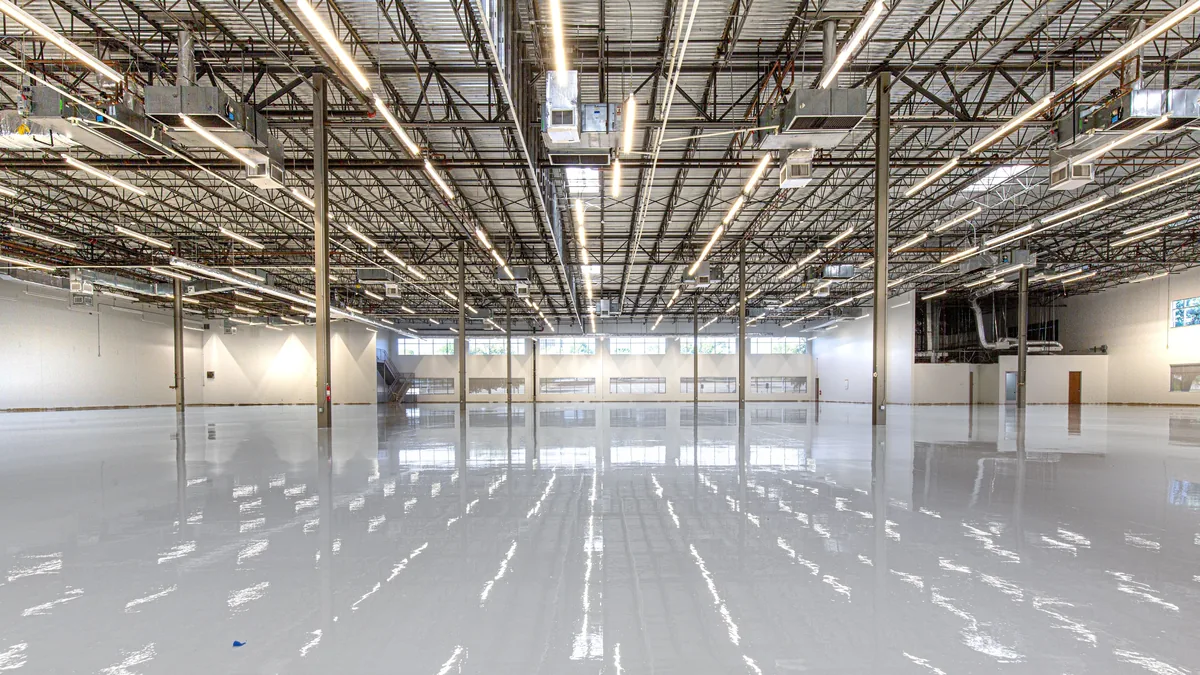
Every other system on this site involves adding material. Polishing removes it. The slab is progressively ground with finer diamond abrasives, chemically densified, and refined until the surface itself is dense, hard and reflective.
There is no coating, so there is nothing to delaminate, and that single fact is why polished concrete has taken over so much commercial and industrial space.
How it works
Coarse metal-bonded diamonds cut first, flattening the slab and removing whatever is on it. Then progressively finer resin-bonded diamonds refine the surface through a sequence of grits.
Partway through, a lithium silicate densifier is applied. It reacts with free lime in the concrete to form additional calcium silicate hydrate within the surface, hardening it and reducing porosity. This is the step that makes polished concrete durable rather than merely shiny.
Finishing continues to the specified grit, then a penetrating guard is applied to help with stain resistance.
Two decisions that define the result
Aggregate exposure
How deep the first cut goes decides what you see.
Cream finish. Minimal grinding. Only the cement paste at the very top is refined, and almost no aggregate shows. Closest to the original slab appearance and the least invasive.
Salt and pepper. A little deeper. Fine sand aggregate becomes visible as a light speckle. The most common choice and generally the safest.
Full aggregate exposure. Deeper still, exposing the large stone in the mix for a terrazzo-like appearance. Dramatic, and dependent entirely on what aggregate your slab happens to contain.
That last point matters. You are revealing what is already there. Nobody knows exactly what a slab poured in 1968 has in it until the grinder goes in, which is why we cut a test area before committing on any floor where full exposure is wanted.
Sheen level
How far up the grit sequence you go, from a matte ground finish through satin to a high gloss. Higher gloss costs more because it is more passes.
Practical guidance: higher gloss shows more, including scratches, dust and footprints. In a busy space a satin finish generally looks better six months in than a mirror does.
Where polishing is the right answer
Converted industrial and warehouse space where the slab is part of the aesthetic. There is a lot of this around Avondale, Parkside and the Lakeview district, and polished concrete belongs in those buildings.
Retail and hospitality wanting a hard-wearing floor with no maintenance layer.
Warehouses and distribution centres where a densified, dust-free slab is the practical requirement and appearance is secondary.
Modern residential interiors, though this is a smaller share of the work here than in some markets.
Where it is not
A slab in poor condition. Polishing reveals. Patches, previous repairs, cracks, colour differences between pours and old adhesive shadows all become part of the finish. Where the slab is a patchwork, a coating that covers is the better answer.
Where you need a specific colour. Polished concrete is the colour of your concrete. Dyes can be introduced during the process to shift it, but the base is what it is.
Wet areas without additional treatment. Polished concrete is slippery when wet. In a commercial wet area it needs a slip-resistant treatment, which compromises the finish.
Chemical exposure. A densified slab resists a lot but it is not a chemically resistant coating. Acids etch it.
Where the slab is too new or too soft. Concrete needs adequate strength and cure to polish well. A weak slab will not take a high polish regardless of how many passes it gets.
Cracks and joints
Polishing does not hide cracks. It makes them cleaner and more visible.
Cracks can be filled with a semi-rigid polyurea and polished over, which makes them read as a deliberate line rather than damage. On a slab with a lot of cracking, that becomes a design decision rather than a repair, and some clients like it.
Control joints usually get filled to support the edges under traffic, and the filler polishes with the surrounding floor.
What it costs
Depends almost entirely on how many passes are needed, which depends on slab condition and the sheen specified. A warehouse floor to a satin salt-and-pepper finish is economical over large areas. A residential floor to high gloss with full aggregate exposure is not.
Removal of an existing floor covering or coating is a separate cost and frequently a large one. Old adhesive is the usual culprit.
Maintenance
The lowest of anything on this site. Dust mop, wet mop with a neutral cleaner, and periodic burnishing to maintain sheen in commercial settings.
No recoating, because there is no coat. Where a heavily trafficked area dulls after years, it can be re-polished from a mid-level grit rather than replaced.
Avoid acidic cleaners, which etch the surface. That is the one real vulnerability.
For a floor where colour is needed, see concrete staining, which can be combined with polishing. For retail spaces weighing the options, retail and showroom flooring.
Common questions
Will it hide my cracks?
The opposite. Polishing reveals everything. Cracks can be filled and polished over so they read as a line rather than damage, which some people prefer to hiding them.
What will my floor look like?
Nobody knows precisely until the first cut. It depends on the aggregate in your slab. On any floor where deep exposure is wanted, we grind a test area first.
Is it slippery?
When wet, yes. In a commercial wet area it needs a slip-resistant treatment, which does compromise the appearance.
How does it compare with an epoxy floor for durability?
It outlasts coatings in most settings, because there is no bond line to fail. Coatings win on chemical resistance and on the ability to specify a colour.
Can it be coloured?
Dyes can be introduced during polishing, and staining can be combined with it. The base remains your concrete.
We have old tile adhesive on the slab. Is that a problem?
It has to come off, and it is usually the largest single variable in the price. Worth identifying before the quote rather than during the work.
Get a free quote
Tell us the space and roughly how big it is. We'll come measure it, and you get the scope and the price in writing.