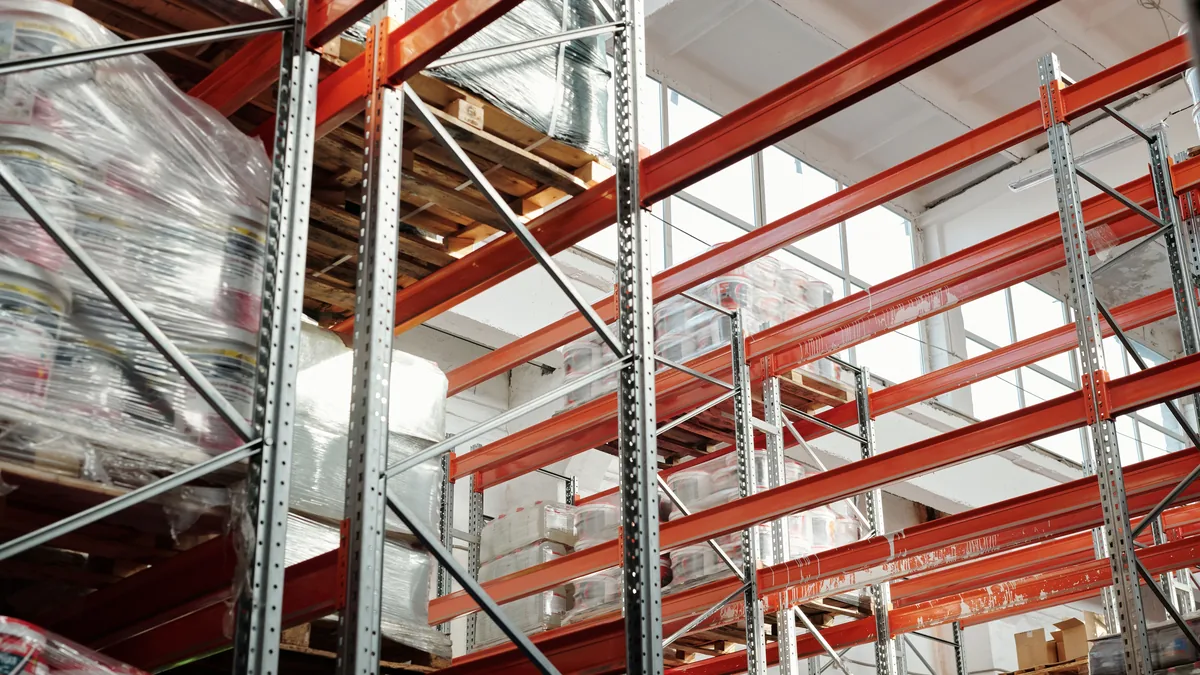
Birmingham has a lot of industrial concrete and much of it is old. The corridors along Finley Boulevard, out toward the airport, the belt of distribution space off I-20 and I-59, the buildings that used to serve the steel industry and now serve logistics: a good deal of that floor was poured decades ago for lighter equipment than currently drives on it.
A warehouse floor coating does four things. It stops the slab dusting into your product and your air. It makes spills recoverable rather than absorbed. It brightens the space, which sounds cosmetic until you price the lighting needed to compensate for grey concrete. And it lets you mark aisles, racking lines and safety zones in a way that survives traffic.
What drives the specification
Traffic type and weight. Pallet jacks, sit-down counterbalance forklifts and reach trucks all load the surface differently. Hard polyurethane wheels concentrate load far more than pneumatic tyres. This sets the film build and the choice of system more than anything else.
What gets spilled. Hydraulic oil and battery acid from the charging area are the usual suspects. Chemical exposure decides the resin family. A floor that will meet sulphuric acid needs a different specification from one that only meets diesel.
Thermal exposure. Dock doors that stand open in August, freezer rooms, wash-down areas with hot water. Thermal shock cracks rigid systems.
Moisture in the slab. Same physics as a basement, larger area. Older industrial slabs frequently have no vapour barrier at all. On a big floor the cost of getting this wrong is enormous, so testing is proportionate rather than optional.
Downtime tolerance. This is usually what actually shapes the job.
Systems we specify
High-build epoxy. Still the right answer for a lot of warehouse floors. It is economical over large areas, builds thickness well, and interior warehouse slabs do not see the UV or the hot tyre problem that rules epoxy out of a residential garage. Where the floor is interior, dry and taking rolling traffic, this is often the sensible specification.
Polyaspartic. Faster return to service, which is the reason to pay more. A section can go down and be back under traffic within hours instead of days. On a facility that cannot stop, that difference pays for itself.
Urethane cement. Where there is thermal shock or aggressive chemistry, particularly in food and beverage. Thicker, more forgiving of a damp slab, and considerably more robust. It is also less pretty, which rarely matters back of house.
Densifier and sealer only. Sometimes the honest recommendation. A lithium silicate densifier plus a sealer hardens the surface, cuts dusting and costs a fraction of a full coating. On a sound slab where appearance is not a driver, this is often better value than a system that is being specified out of habit.
Joints, cracks and the parts people forget
Control joints in an industrial slab take a beating from hard-wheeled traffic, and spalled joint edges are the most common failure we see. Filling them with a semi-rigid polyurea supports the edges and stops the chipping that eventually turns into a repair the forklift driver feels.
Joints that are still moving need to stay joints. Filling a live joint solid means it cracks somewhere else, usually in a worse place. Part of the survey is working out which is which.
Dock plates, drain surrounds, column bases and the transition at every roller door are where a coating either terminates properly or starts peeling. They take longer per square foot than the open floor by a wide margin.
Line striping and marking
Aisle lines, pedestrian walkways, racking footprints, hatched exclusion zones around switchgear and eyewash stations, and floor-marked staging areas. Applied as part of the coating system rather than as tape, so it survives the traffic that tape does not.
This is worth planning properly before we arrive. Marking that reflects how the building actually operates is far more useful than marking that reflects how the drawing said it would.
Scheduling around a live operation
Very few facilities can hand over the whole floor. Most jobs get phased: a bay or an aisle at a time, sequenced so that racking is emptied and put back with the least disruption. Nights and weekends are normal on this kind of work.
Polyaspartic exists in this conversation almost entirely because of return-to-service time. Where a section has to be back under a forklift the same shift, that is what makes it possible.
Containment matters too. Grinding and shot blasting produce dust, and dust in a warehouse that stores anything food-related or electronic is a problem in its own right. Sections get screened and extraction runs continuously.
Surface preparation at scale
On large areas, shot blasting replaces diamond grinding for the open floor. A shot blaster propels steel shot at the slab, and it profiles concrete much faster than grinding over big square footages, with the debris recovered inside the machine. Edges, corners and around obstructions still get ground by hand.
The target is the same as on any other job: an open, sound profile with nothing on it that the coating will bond to instead of the concrete.
Getting a price
For a warehouse we need to walk the floor. Square footage alone will not do it, because the variables that move the number are joint condition, slab moisture, how much of the area is obstructed, and how much of the work has to happen out of hours.
We will give you a written scope with the preparation method, the system, the film build and the phasing named, so you can compare it against anything else you are holding rather than comparing two totals that describe different work.
For food production and kitchen environments, see commercial kitchen flooring, where the specification is different. For workshops and service bays, auto shop floor coating covers it.
Common questions
Can you work around our operation?
Almost always, in phases and usually out of hours. It costs more per square foot than an empty building and is still cheaper than stopping.
How long before forklifts can drive on it?
With polyaspartic, hours. With a high-build epoxy, typically several days to full chemical cure, though foot traffic comes back sooner. Return-to-service time is often the reason to pick one over the other.
Our slab has no vapour barrier. Is it hopeless?
No, but it has to be tested and the system chosen accordingly. Urethane cement and moisture-mitigating primers exist precisely for this. What does not work is applying a low-permeability coating and hoping.
Is a densifier enough for us?
Sometimes. If the slab is sound, the main complaint is dusting, and appearance is not driving the decision, a densifier and sealer may be the better spend. We will tell you when we think that is the case.
Can you match our safety marking standard?
Yes, including colour conventions your health and safety policy already specifies. Bring the standard to the survey.
What about the dust during preparation?
Shot blasting recovers most of its own debris. Grinding runs on vacuum extraction. Work areas get screened off, which matters most in facilities storing food or electronics.
Get a free quote
Tell us the space and roughly how big it is. We'll come measure it, and you get the scope and the price in writing.