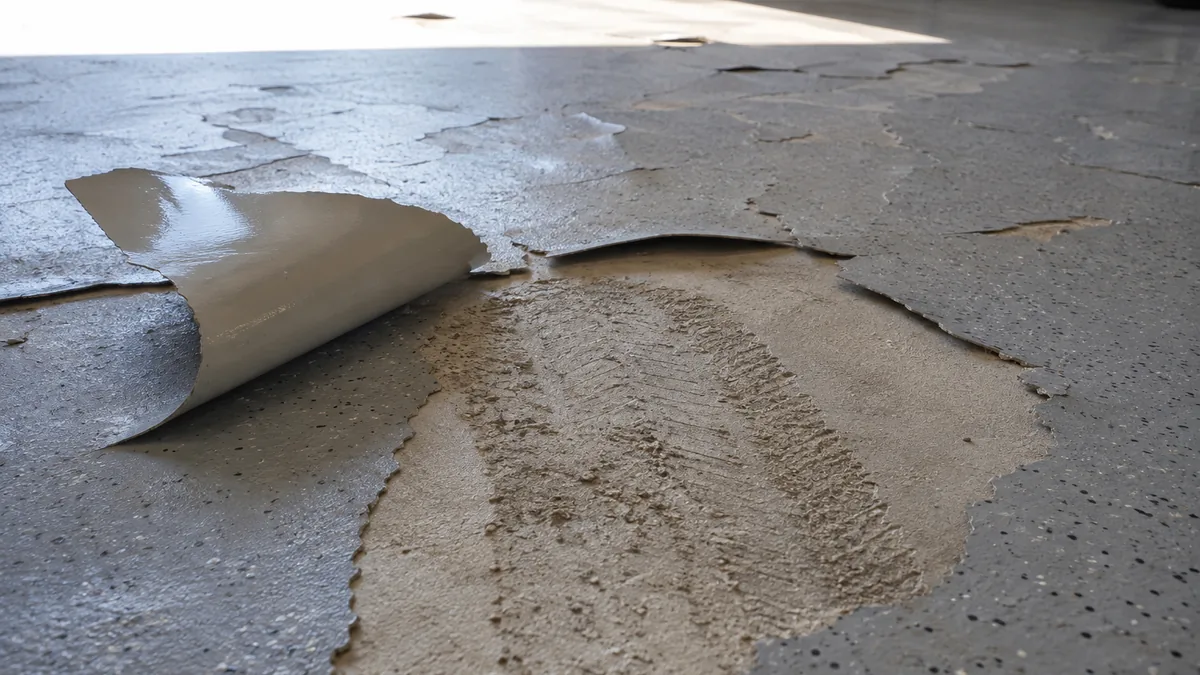
This is a bigger part of our work than we would like. Somebody paid for a garage floor two or three years ago, it looked excellent, and now it is peeling in sheets by the door or bubbling in the middle.
Before anything else: do not let anyone recoat over it. New product on top of a failing bond fails at the same bond line, and now you have paid twice.
The three reasons floors fail here
1. The slab was never properly prepared
The most common by a distance. The concrete was acid-etched, or pressure-washed, or lightly scuffed, instead of being ground with diamond tooling until the surface was open.
How to spot it: the coating comes off in large flexible sheets and the underside is clean and glossy, with no concrete stuck to it. The slab underneath looks smooth and closed. That means the coating never keyed into the concrete at all — it was sitting on top like a sticker.
2. Moisture coming up through the slab
Water vapour moving up through concrete arrives at the underside of the coating and cannot get out.
How to spot it: bubbles and blisters rather than peeling, often in a patch rather than at edges, and often with a chalky white residue underneath from dissolved salts carried up with the moisture. Common in basements and in garages on slabs poured before vapour barriers were routine.
3. Hot tyre pickup
Specific to garages and specific to rigid coatings. A warm tyre bonds to the coating and pulls it off the slab on the way out.
How to spot it: it is unmistakable. The damage is in the shape of your tyres, in the parking positions, and nowhere else. The rest of the floor is fine.
Diagnosis before quoting
We look at where the failure is, what the underside of a lifted piece looks like, whether concrete is attached to it, and whether the pattern matches parking positions.
Where moisture is suspected we test the slab rather than guess, using calcium chloride or relative humidity probes. Where a previous coating is unknown, a small area gets ground to see how it behaves and how many layers are down there.
This matters because it determines the scope. A floor failing from hot tyre pickup on a well-prepared slab is a different job from one that was never ground properly, which is different again from one with vapour drive.
Removal
The unglamorous part, and often the expensive part.
Poorly bonded coatings can come up in sheets with a scraper, which is quick. Well-bonded ones have to be ground off, which is slow and consumes tooling. Thick industrial build-ups may need shot blasting.
It is entirely normal for removal to cost more than the new coating. That surprises people, and it is why a quote for recoating a failed floor is not comparable to a quote for coating bare concrete. If somebody has given you a similar price for both, they are probably not planning to remove anything.
Multiple layers make it worse. Some floors have had two or three attempts at this over the years, each bonded to the last.
Fixing the cause
Bad preparation: the fix is doing it properly. Grind to an open profile, verify it across the whole floor including edges and corners.
Moisture: a moisture-mitigating primer, which is an epoxy formulated to tolerate high vapour drive and act as a barrier. Where readings are extreme, or where the source is fixable, sometimes the right answer is drainage work outside first.
Hot tyre pickup: change the system. A flexible polyurea base with a polyaspartic topcoat does not have this failure mode.
Partial repair versus full replacement
People ask whether just the bad patch can be redone. Sometimes.
It works when the failure is genuinely localised and the surrounding coating is well bonded, typically hot tyre damage on an otherwise sound floor. The repair area gets ground back to sound edges, feathered, and recoated. There will be a visible line unless the whole floor gets a fresh topcoat over the top, which is often worth doing anyway.
It does not work when the cause is general. If the slab was never ground, the parts that have not failed yet are going to. Patching that floor is buying a few months.
We will tell you honestly which situation you are in, including when the answer is that you have another year or two before it needs doing and there is no urgency.
What to ask the next contractor
Whoever does this work, ask them why your floor failed. If they cannot tell you, or they say "bad product", find someone else. Product is rarely the cause. Preparation and moisture are.
Ask what preparation method they are using and get the word "grinding" or "shot blasting" in the answer, not "etching".
Ask whether they are testing for moisture, particularly if you have blisters rather than peeling.
And ask what happens if removal turns out to be worse than expected once they start. A defined process for stopping and re-quoting is a good answer.
For what should go down afterwards, see polyaspartic coating. If the floor in question is a basement, basement floor coating covers the moisture side in more detail.
Common questions
Can you just coat over my peeling floor?
No. Whatever goes on top is only as attached as what is underneath, and what is underneath is letting go. Anyone offering to do this is selling you a repeat.
Why is removal so expensive?
Grinding a bonded coating off is slow and eats diamond tooling. On a well-bonded failure it can genuinely cost more than the new floor. It is also the reason quotes vary so widely on this work.
My floor is bubbling, not peeling. Different problem?
Usually yes. Blistering points at moisture from underneath rather than poor preparation. That one gets tested before anybody quotes.
The damage is only where I park. Is the rest fine?
Probably, and that pattern is hot tyre pickup. If the surrounding coating is well bonded it can often be repaired locally, then given a fresh topcoat across the whole floor so there is no visible line.
How do I know if it was ground properly the first time?
Lift a loose piece and look at the back. Concrete stuck to it means it was bonded. Clean and glossy means it never keyed in.
Is it worth repairing or should I leave it?
If it is cosmetic and stable, leaving it is a legitimate choice. If it is spreading, water is now reaching bare concrete under the remaining coating and it will accelerate.
Get a free quote
Tell us the space and roughly how big it is. We'll come measure it, and you get the scope and the price in writing.