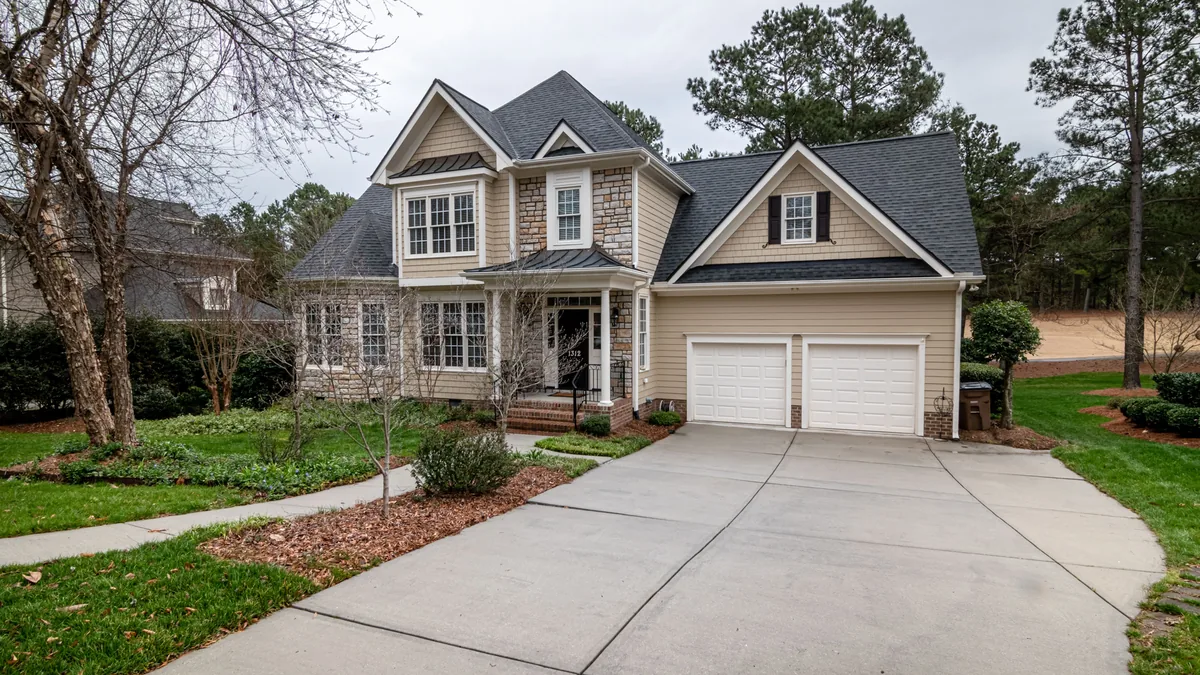
A driveway is not a big patio. It carries vehicle loads, it is usually the largest single slab on the property, it has more joints, and it takes point loading from tyres turning while stationary. All of that changes what can go on it and whether anything should.
We coat driveways regularly. We also talk people out of coating driveways regularly, and it is worth explaining both.
When a driveway is a good candidate
Sound concrete with cosmetic problems. Staining from oil, tyre marks, general greying, surface dullness, minor shrinkage cracking. The slab is structurally fine and looks tired. That coats well and the result lasts.
Newer driveways where the owner wants to protect the surface before it deteriorates. Preventive rather than remedial, and the easiest version of this job.
Driveways where appearance genuinely matters, typically because the approach is visible from the street and the rest of the property is finished to a high standard.
When it is not
Settlement cracking with displacement. If one side of a crack sits higher than the other, the slab has moved. Coating over it hides it briefly and then the crack telegraphs through. The movement has not stopped.
Heavy spalling across large areas. Where the top layer has broken down over most of the surface, you are coating over friable material. It takes the coating with it.
Asphalt. These systems bond to concrete. Asphalt flexes and softens with heat and is not a candidate for any of this.
Very steep approaches with heavy vehicle turning. Point loading from a turning tyre on a slope is about the hardest thing you can do to a coating. It can be specified for, but it needs to be specified for deliberately.
Flexibility over hardness
Counterintuitive but important. On a driveway the priority is a system that moves with the slab rather than one that is as hard as possible.
A driveway in Birmingham expands and contracts through a substantial annual temperature range, in direct sun, on a slab that is often thirty or forty feet long. That movement is real and it is unavoidable. A rigid coating resists it and eventually cracks or debonds at the bond line. A flexible polyurea-based system rides it.
This is the same reason epoxy is the wrong answer here, on top of the UV problem.
Joints
Control joints exist to tell the slab where to crack. They have to keep doing that job after the coating goes on.
Filling them solid with a rigid material means the slab cracks somewhere else, usually in the middle of a bay where you will mind much more. Live joints get treated with a flexible sealant and remain visible as joints. That is the correct outcome, not a compromise, and anybody promising you a seamless driveway is either not going to deliver it or is storing up a crack.
Texture and safety
A driveway is walked on, often carrying shopping, often in the rain, and frequently on a slope. Aggregate in the topcoat is not optional here in the way it might be on a covered porch.
Slope also means water runs across it. Where a driveway falls toward a garage door, that transition takes water constantly and is the first place a poorly detailed job fails.
Preparation on a large outdoor slab
Driveways are big, and preparation scales accordingly. Diamond grinding on smaller residential drives, shot blasting where the area justifies the machine. Either way the target is the same: open profile, nothing loose, no existing sealer left in place.
Most Birmingham driveways have had something applied at some point, often a cheap acrylic sealer from a hardware store, sometimes more than once. All of that comes off. A new system bonded on top of an old sealer inherits the old sealer's adhesion, which is generally poor.
Oil staining needs degreasing before grinding. Oil that has soaked deep into porous concrete can wick back up and interfere with the bond, and the worst spots sometimes need to be cut out.
The alternative worth considering
For a lot of driveways, the better value is not a coating at all. A lithium silicate densifier hardens the surface and cuts dusting; a penetrating silane or siloxane sealer repels water and reduces staining without forming a film on top.
Neither changes the colour much. Neither can peel, because there is nothing sitting on the surface to peel. Both cost a fraction of a coating system.
If your complaint is "it stains and it dusts" rather than "it looks bad", that is probably the right spend. We will say so.
What it costs and what moves the number
Square footage first, because driveways are large. Then condition, then how much removal of previous sealers is needed, then joint work.
A driveway is usually the largest coating project on a residential property, and it is the one where the price per square foot comes down most with area. It is also the one where the price of getting it wrong is highest, because there is nowhere to hide a failure on the approach to the house.
For the walkways either side of it, see walkway and sidewalk coating. For the garage floor at the end of it, garage floor coating.
Common questions
Will car tyres damage it?
Not a flexible polyurea-based system with a proper topcoat. Rigid epoxy on a driveway is a different story, particularly with warm tyres and turning loads.
Can you coat asphalt?
No. These are concrete systems. Asphalt moves and softens in heat and nothing here will bond to it reliably.
Will the joints still show?
Yes, and they should. A joint is there to control where the slab cracks. Filling it rigid moves the crack somewhere worse.
My driveway has a big crack across it. Is it worth coating?
Depends whether it is moving. If the two sides are level and it is a shrinkage crack, it can be repaired and coated. If one side has dropped, the slab has settled and a coating is decoration over a fault.
Is a sealer enough for me?
Quite possibly. If your complaint is dusting and staining rather than appearance, a densifier and penetrating sealer costs far less and cannot peel. We will tell you when we think that is the better option.
How long is the driveway out of use?
Typically 24 hours before vehicles, longer in cool or damp weather. You will need somewhere else to park for the day of the work and the night after.
Get a free quote
Tell us the space and roughly how big it is. We'll come measure it, and you get the scope and the price in writing.