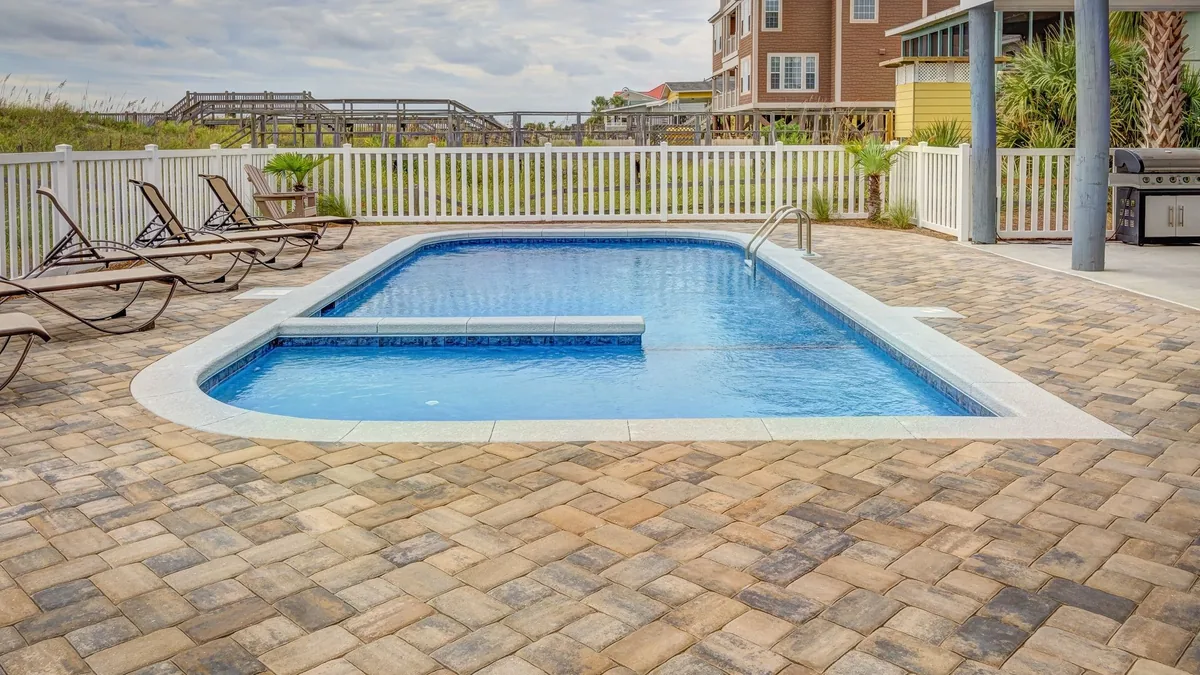
Of all the concrete we coat, a pool deck has the hardest brief. It is wet constantly, walked on barefoot, sits in full sun, and takes chlorinated or salt-system water splashed across it every day of the season.
Get it right and it is the best surface around a pool. Get it wrong and you have built something that is either slippery or too hot to cross, and both of those get noticed immediately.
Heat is a colour decision
This is the part homeowners underestimate. Surface temperature in direct sun is driven overwhelmingly by colour and reflectivity, not by what the product claims.
A dark solid coating in a Birmingham July afternoon becomes genuinely unpleasant on bare feet. A light flake blend in tans, greys and off-whites stays substantially cooler. The difference is large enough that it decides whether the deck gets used in the middle of the day at all.
Texture helps too, because a broken surface has less continuous contact with the sole of a foot than a smooth one does. This is the same reason textured pavers feel cooler than smooth tile at the same colour.
So the first conversation is not about product. It is about how light you are willing to go.
Slip resistance, properly specified
The other half of the brief. A pool deck is wet by definition, and people run on it whatever the sign says.
Grip comes from aggregate broadcast into the topcoat. The grade is a real decision with a real trade-off: coarser aggregate grips better and is harsher underfoot; finer aggregate is comfortable and gives up some traction. On a pool deck we generally go coarser than we would on a patio, because the consequence of getting it wrong is worse.
Where the deck slopes, and at every step and coping edge, coarser again. Tell us where children run and where the ladder is, because those are the spots that matter.
Chlorine, salt and sunscreen
Three chemical exposures that a patio does not have.
Chlorinated water splashed repeatedly is mildly aggressive over years. A polyaspartic topcoat handles it; a cheap acrylic sealer does not.
Salt water systems are gentler chemically but leave crystalline deposits as water evaporates, and those are abrasive underfoot over time.
Sunscreen and body oils are the ones nobody mentions. Modern mineral sunscreens can stain porous surfaces stubbornly. A sealed coating resists this; bare concrete around a busy pool goes patchy within a couple of seasons.
What we look at before quoting
The coping and the waterline. Where the deck meets the coping stone is the detail that decides whether the job looks finished. The termination has to be clean and it has to be sealed, because water sits in that joint constantly.
Spalling. Very common on pool decks, because the surface is repeatedly wetted and dried and, in older installations, may have taken de-icing salt at some point. Loose material comes off before anything goes on.
Drainage and fall. A deck should shed water away from the pool. Where it ponds, you get algae in the low spots and a slippery patch that no coating fixes.
Existing sealers. Many pool decks have had an acrylic sealer applied at some point, sometimes several times. That has to come off completely by grinding, because a new system bonded to a soft old sealer is only as attached as that sealer is.
Coating or overlay
Where the concrete is sound, a bonded coating system is the answer: grind, repair, base coat, flake, aggregate and UV-stable topcoat.
Where the deck is heavily spalled, or where it is smooth trowelled concrete that has never had texture, a cementitious overlay may serve better. A knockdown or textured overlay creates grip in the substrate itself rather than relying entirely on aggregate in the topcoat, and it can correct minor fall problems at the same time.
Both get finished with the same UV-stable topcoat. The difference is what happens underneath.
Scheduling around a pool season
The work needs the deck dry and dry for the duration of the cure, which means the pool cannot be splashing across it and rain has to stay away. Spring before the season opens is the natural window. Autumn works too.
Mid-summer is possible but awkward: the crew starts early because slab temperature climbs fast in direct sun, and the pool needs to be out of use for a couple of days.
What it will not do
It will not fix a structurally failing deck. Where slabs have settled and lifted at joints, that is a levelling problem first.
It will not stop algae in a low spot that holds water. Standing water is a drainage question.
And it will not make a deck cool if you insist on a dark colour. We will show you the samples in daylight and tell you honestly which ones will be uncomfortable in August, and then it is your call.
For the adjacent patio area, see patio coating. For the topcoat chemistry that makes any of this survive Alabama sun, see polyaspartic coating.
Common questions
How hot does it get compared with bare concrete?
A light flake blend is usually comparable to or cooler than bare grey concrete. A dark solid colour is hotter. The coating itself is thin enough that colour dominates the result.
Is it safe for children running on it?
With the right aggregate grade, yes, and considerably safer than smooth sealed concrete. Tell us where they run and we will specify accordingly.
Will chlorine damage it?
Not a polyaspartic topcoat at pool concentrations. Rinsing the deck occasionally helps with salt deposits on saltwater systems.
Can you coat right up to the coping?
Yes, and how that edge is terminated and sealed is one of the details that separates a good job from a scruffy one.
My deck already has a sealer on it. Is that a problem?
It has to come off by grinding. Bonding a new system to an old acrylic sealer means the whole floor is only as attached as that sealer, which is not very.
How long is the pool out of use?
Usually a couple of days, allowing for preparation, application and initial cure. We will give you the actual window when we have seen the deck.
Get a free quote
Tell us the space and roughly how big it is. We'll come measure it, and you get the scope and the price in writing.