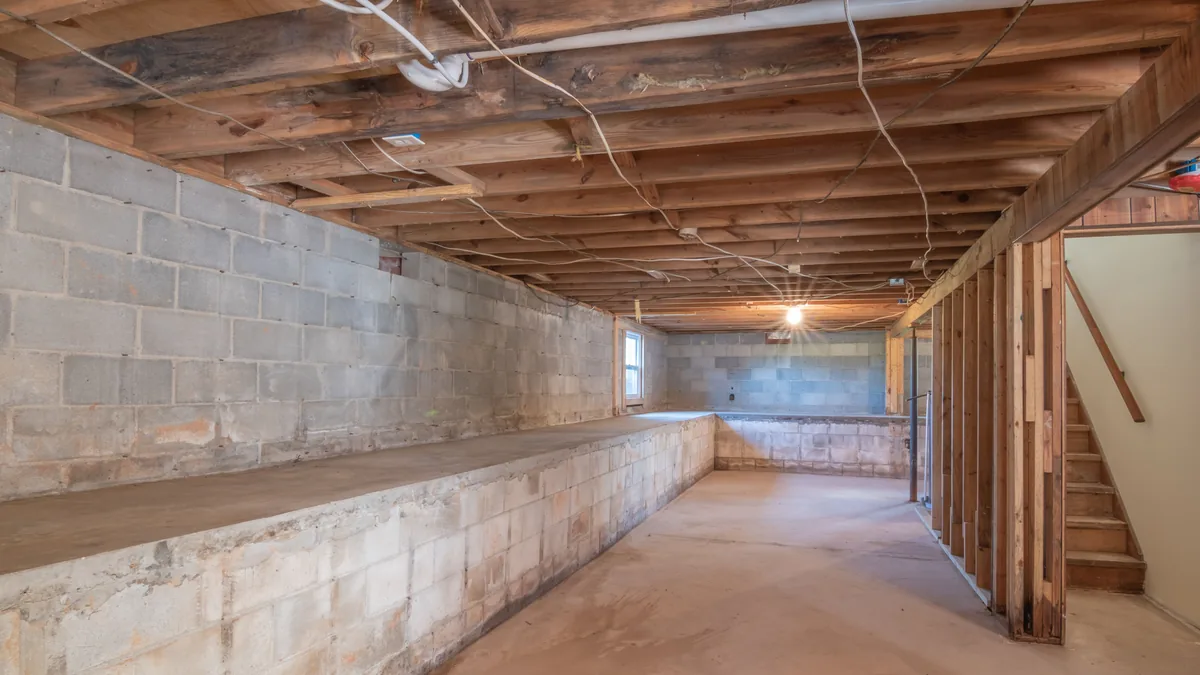
A finished basement floor turns storage into a room. That is worth real money in a Birmingham house, where the basement is often the coolest space in the building for four months of the year.
It is also the single job where we most often tell people to wait, or to fix something else first. Not because basements cannot be coated, but because a coating applied over a slab that is pushing moisture upward will fail from underneath, and there is no product that gets around that.
Why basements are different
A garage slab sits on grade with the edges exposed and air moving over it. A basement slab is surrounded by soil on all sides and often below the water table after a wet week. Water vapour moves through concrete from the damp side to the dry side, always, and in a basement the dry side is your floor.
Older Birmingham housing makes this sharper. A great deal of the stock in Homewood, Crestwood, Forest Park and around Southside predates the routine use of polyethylene vapour barriers under slabs. The concrete is often good concrete. It simply has nothing between it and the ground.
Put a low-permeability coating over a slab with active vapour drive and the moisture arrives at the bond line, cannot go further, and lifts the coating in blisters. This usually shows up in the second year, not the first, which is why so many people find out the expensive way.
How we check before quoting
Calcium chloride test. A measured dish of anhydrous calcium chloride is sealed to the slab under a dome for 60 to 72 hours and weighed before and after. The weight gained tells you the moisture vapour emission rate, expressed in pounds per 1,000 square feet per 24 hours.
Relative humidity probes. Small holes are drilled into the slab to a set depth and a probe reads the internal relative humidity. This is generally the more reliable of the two on modern concrete because it reads inside the slab rather than at the surface.
The plastic sheet check. Crude but free, and worth doing yourself before you call anyone. Tape a square of clear plastic sheet tightly to the floor on all four edges and leave it for two days. Condensation underneath means vapour is coming through the slab. A dry sheet does not prove the slab is fine, but a wet one proves it is not.
Where readings come back high, the answer is usually a moisture-mitigating primer, which is an epoxy formulated specifically to tolerate high vapour drive and act as a barrier before the finish system goes on. It adds cost. It also stops you paying twice.
The part that is not the floor
Sometimes the honest recommendation is to spend the money outside instead. Gutters discharging at the foundation, downspouts without extensions, negative grade sloping soil back toward the house, a failed or absent French drain: any of these will keep loading the soil around your basement with water regardless of what we put on the concrete.
We would rather tell you that on the first visit than coat over it. It costs us the job and it saves you a floor.
What goes down once the slab is right
The system itself follows the same logic as a garage. Diamond grinding to open the surface. Crack and joint treatment. A moisture-mitigating primer where the readings call for one. Then a polyurea base coat, flake broadcast, and a polyaspartic topcoat.
Two things differ from a garage. First, basements often have more complex layouts, with stairs, mechanical rooms, support columns and doorways to cut around, so there is more edge work. Second, appearance tends to matter more, because people sit in this room rather than parking in it. Lighter flake blends make a windowless basement feel bigger; a very dark solid colour will do the opposite.
Ventilation and dust during the work
Grinding a basement is dustier than grinding a garage for the obvious reason that there is nowhere for it to go. Extraction runs off the grinder, and the space gets sealed off from the rest of the house at the stair door. It is worth planning to be out of the house for the day if anybody in the family has asthma.
Odour during application is low with polyurea and polyaspartic compared with solvent-based epoxies, which is another practical reason those systems have taken over interior residential work.
What it costs
A basement of comparable size to a two-car garage costs more, for three reasons: more cutting-in around obstructions, the likelihood of a moisture-mitigating primer, and often a need to grind out old adhesive, paint or tile mastic from a previous life as a finished room. That last one is worth checking before you get quotes. A slab with black cutback adhesive on it is a different job from a bare one.
Where a moisture test is needed, we would rather do it and know than guess and hope.
When a coating is the wrong answer
If your basement takes standing water in heavy rain, no floor coating is the fix. If the slab has structural cracking with vertical displacement between the two sides, that is a foundation question and not a finishes question. And if the readings come back very high and the drainage outside cannot be improved, sometimes the right advice is a floating floor system with an air gap rather than a bonded coating.
We will say so. It is a smaller conversation than the one that happens two years after a floor blisters.
If your basement is dry and you are simply choosing a finish, our polyaspartic page covers the topcoat. If you are dealing with a floor that already failed, go to repair and recoating.
Common questions
My basement smells musty. Will a coating fix that?
No, and it may hide the cause. A musty smell means moisture is present somewhere. Find out where before sealing the floor, because a coating over a wet slab traps the problem rather than removing it.
How long does a moisture test take?
Calcium chloride tests need 60 to 72 hours in place. RH probes need about 24 hours to equilibrate. Either way it means two visits, which is why it is worth starting the conversation before you are in a hurry.
Can you coat over old tile adhesive?
Not directly. It has to be ground off, and black cutback adhesive in particular needs care. Tell whoever quotes you that it is there, because it changes the price.
Is it warm underfoot?
No warmer than the concrete beneath it. A coating is a few dozen mils thick and has no insulating value. If warmth matters, that is an underlay and floating floor conversation.
What about the stairs?
Concrete stairs can be coated to match, with aggregate added to the topcoat for grip. Wooden stairs cannot, and normally get finished separately.
Will it survive a flood?
The coating itself is unaffected by water sitting on top of it, which is one of its advantages over any floor with an organic layer. What it will not survive is water arriving from underneath through the slab.
Get a free quote
Tell us the space and roughly how big it is. We'll come measure it, and you get the scope and the price in writing.