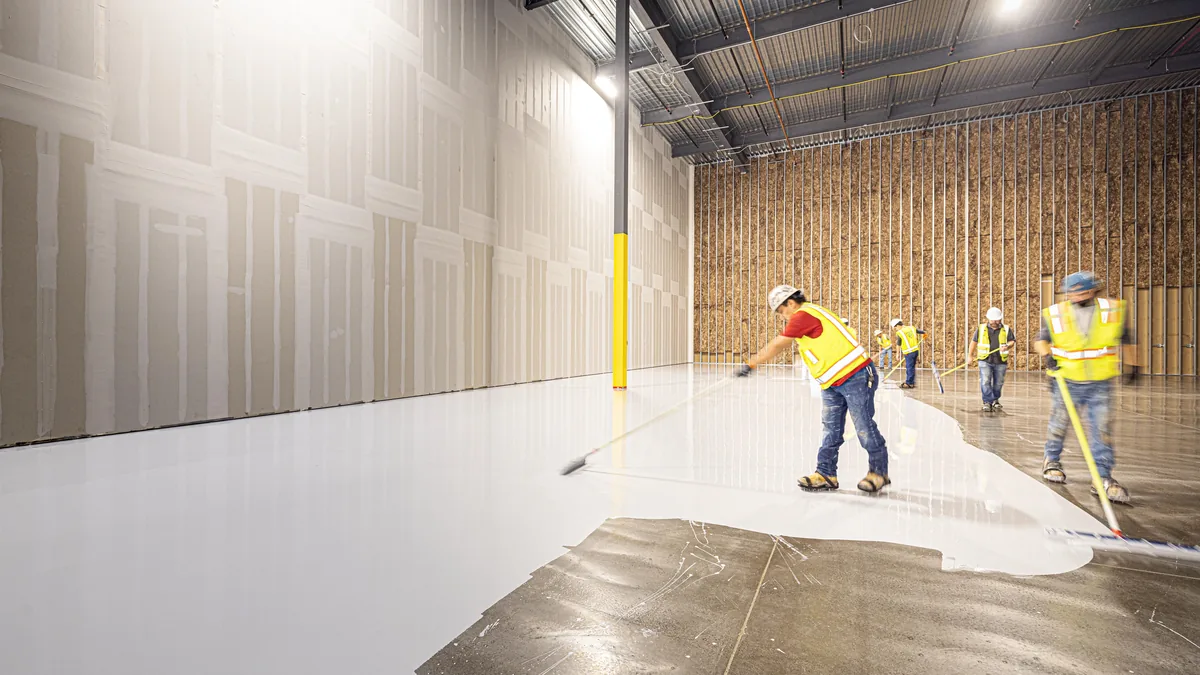
If polyaspartic is the topcoat that survives sunlight, polyurea is the base coat that stays stuck to the concrete. Most decent residential floor systems in this city are one on top of the other, and understanding what each does helps you read a quote.
What polyurea is
Polyurea is formed by reacting an isocyanate with an amine-terminated resin. The reaction is fast, and in its pure form extremely fast, which is why industrial polyurea is spray-applied by machine and cures in seconds.
For floor coating, the formulations are slowed to give a workable window of several minutes, long enough to roll out and broadcast flake into.
Two properties matter for floors. It is flexible, with high elongation, meaning it stretches rather than cracking as the slab moves. And it has excellent adhesion into a properly ground concrete profile.
The hot tyre problem it solved
This is the reason polyurea took over residential garage work, and it is worth understanding because it is the most common failure we are called to fix.
A tyre coming off the interstate in an Alabama summer is genuinely hot. Park on a rigid coating and the warm rubber softens the surface slightly and bonds to it. The coating is stuck to the concrete on one side and to your tyre on the other. When you reverse out, whichever bond is weaker gives up.
With epoxy, that is frequently the concrete bond, and the coating lifts in tyre-shaped patches. With a flexible polyurea, the coating deforms slightly rather than releasing, and the bond survives.
It is not a marketing distinction. It is the single biggest practical difference between a floor that lasts a decade in a Birmingham garage and one that does not.
Flexibility and slab movement
The second reason. An uninsulated garage in this city swings from near freezing on a January night to well above 40°C on an August afternoon. A twenty-foot slab expands and contracts measurably through that range.
A rigid coating resists that movement and eventually loses, either by cracking or by debonding at the edges. A flexible one accommodates it. On outdoor concrete, where the swing is larger, this matters more still.
Where polyurea sits in the system
Almost always underneath, for one specific reason: aromatic polyurea is not UV-stable. Exposed to sunlight it yellows and chalks, exactly like epoxy.
So the typical build is a pigmented polyurea base coat into the ground profile, vinyl flake broadcast into it wet, then a UV-stable polyaspartic topcoat over the top. The polyurea provides adhesion and flexibility, the polyaspartic provides UV stability, abrasion resistance and the finish.
You will see companies advertise "polyurea floors" and "polyaspartic floors" as though they are competing products. In practice a good residential floor is both, and a quote that names only one is not telling you what is actually going down.
Aliphatic polyurea
Worth a note because it complicates the tidy story above. Aliphatic polyureas exist and are UV-stable, and polyaspartic is itself a subset of aliphatic polyurea chemistry. So "polyurea" and "polyaspartic" are not two families, they are a family and one of its branches.
In everyday trade usage, "polyurea" means the aromatic base coat and "polyaspartic" means the aliphatic topcoat. That is how it is meant on virtually every quote you will receive.
What it will not fix
Flexibility is not adhesion to a bad surface. Polyurea on an unground, acid-etched or sealed slab fails as readily as anything else. The single largest predictor of how long any floor lasts remains what happened before the first coat went on.
It also does not solve moisture. A slab with active vapour drive pushes any coating off from underneath, and the fix for that is a moisture-mitigating primer, not a more flexible topcoat.
And it is not a structural product. A cracked, settling slab is a concrete problem and a coating over it is decoration.
Application conditions
Polyurea tolerates a wider temperature and humidity range during application than epoxy does, which in practice means more workable days in an Alabama year. That is a real advantage in a climate where summer humidity is high for months.
The working window is short, though, and that is the trade-off. A crew has minutes rather than hours to roll and broadcast before the material is beyond working. It punishes inexperience, and a rushed polyurea install shows in the flake distribution.
Cost
Per gallon, polyurea costs more than epoxy. Per floor, the difference is smaller than people expect, because the system is applied at a different film build and the labour is compressed into one day rather than spread across three.
Where the cost genuinely goes up is on very large areas, and that is why high-build epoxy remains the sensible specification for a warehouse interior where hot tyres and UV are not factors.
For the topcoat that goes over it, see polyaspartic coating. For how the whole system is installed on a real floor, garage floor coating.
Common questions
Is polyurea better than polyaspartic?
Wrong comparison. They do different jobs in the same system. Polyurea bonds and flexes underneath; polyaspartic resists UV and abrasion on top.
Can polyurea be used as a topcoat?
Aromatic polyurea should not be, because it yellows in UV. Aliphatic versions can, and polyaspartic is the aliphatic branch of the same family.
Does it really stop hot tyre pickup?
In practice yes, and that is the main reason it replaced epoxy on residential garages. The flexibility means the coating deforms rather than releasing from the slab.
Why is it applied so fast?
The chemistry cures quickly by design. Formulations for hand application slow it to a few minutes of working time, which is enough to roll and broadcast but leaves no room for hesitation.
Is it worth it on a basement floor?
The flexibility matters less indoors where temperature swing is small. What matters more in a basement is moisture testing and, where needed, a mitigating primer.
Can it go over my existing epoxy?
Only if that epoxy is fully sound and properly abraded. If any of it is letting go, all of it comes off first.
Get a free quote
Tell us the space and roughly how big it is. We'll come measure it, and you get the scope and the price in writing.