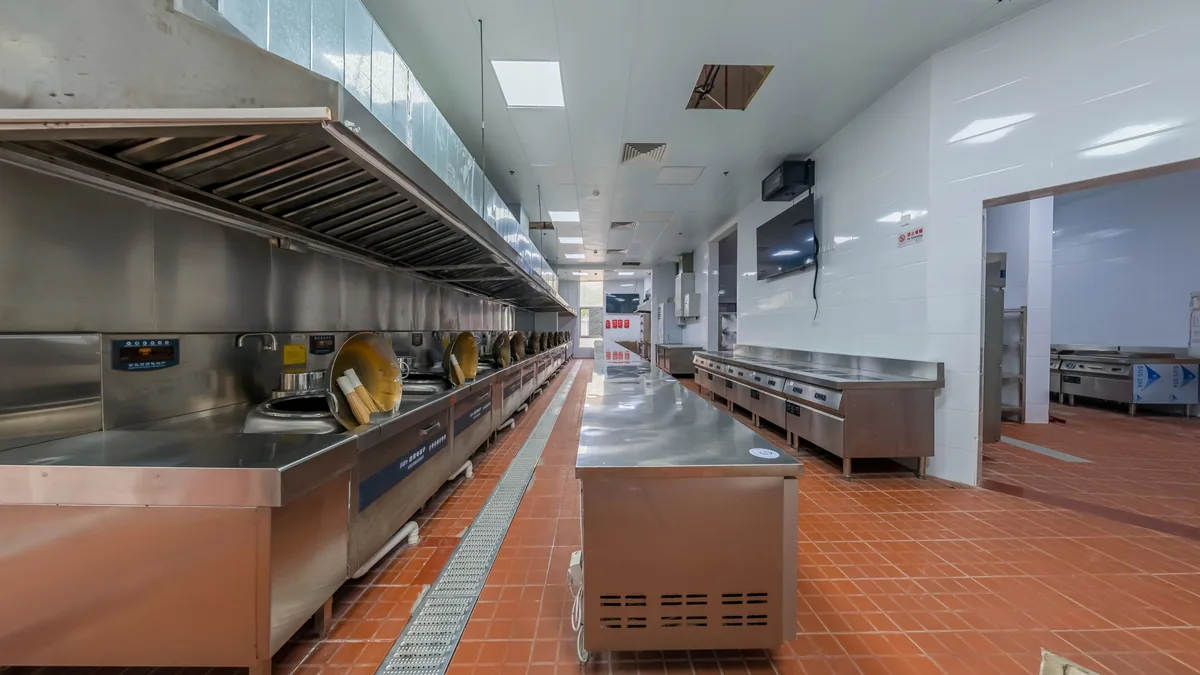
Birmingham has a serious restaurant scene, and behind every dining room is a floor taking abuse that no other commercial surface takes. If you run a kitchen anywhere from Avondale to Lakeview to the Pizitz food hall, you already know what your floor looks like after three years.
Kitchen floors fail for reasons that have nothing to do with foot traffic.
What actually attacks a kitchen floor
Thermal shock. The big one. Boiling water or hot oil hits a floor at ambient temperature and the surface expands instantly while the concrete beneath does not. Rigid coatings crack and debond. This happens near fryers, kettles, dishwashers and anywhere pots get emptied.
Animal fats and food acids. Lactic acid from dairy, acetic acid from vinegar, citric acid, and animal fats. These are more aggressive to resin systems than most people expect, and considerably more aggressive than the oil in a warehouse.
Steam and hot water cleaning. Daily. Pressure washing and steam cleaning drive water into any weakness and repeat the thermal shock cycle every shift.
Standing water. Kitchen floors get wet and stay wet. Anywhere water sits, it finds its way into a joint or a pinhole.
Impact. Dropped pans, trolleys, equipment being moved.
Why urethane cement
Urethane cement, sometimes called urethane mortar or polyurethane concrete, is a hybrid of polyurethane resin and cementitious aggregate. It is applied considerably thicker than a coating, typically in the range of a quarter of an inch, and trowelled rather than rolled.
Its coefficient of thermal expansion is close to that of concrete, which is the whole point. When boiling water lands on it, it moves at roughly the same rate as the slab underneath, so there is no shearing at the bond line. That is what epoxy cannot do.
It also tolerates a damp slab far better than epoxy, which matters in an existing building where you cannot always get the concrete as dry as a datasheet wants. And it can be laid over a slab that is not perfectly prepared to the standard a thin coating would demand.
It is not pretty. It looks like what it is: a functional industrial floor. In a back-of-house kitchen that is exactly right.
The details that pass inspection
Coved bases. The floor turns up the wall in a curve rather than meeting it at a right angle. This eliminates the joint where water, grease and food debris collect, and it is what allows a floor to be hosed and squeegeed properly. It is also usually what a health inspector looks for first.
Falls to drain. Water has to go somewhere. Where the existing slab does not fall to the drains, urethane cement can be laid to a screed and graded, which a thin coating cannot do. This is often the real reason to choose the system.
Drain terminations. The floor has to be cut in around drains and gullies with a mechanical key, not just butted up. This is a common failure point in cheaper installations.
Slip resistance. A wet, greasy kitchen floor needs genuine texture. Aggregate is broadcast into the system to a specified grade, balanced against being cleanable, because a floor too rough to clean creates a different problem.
Working around a live kitchen
This is usually the hardest part of the project, harder than the floor itself.
Most kitchens cannot close for a week. Work gets phased by zone, typically overnight or across a closure day, with equipment moved and sections isolated. Some urethane cement systems return to service within hours of application, which is often what makes the schedule possible at all.
Equipment has to come out of the zone being worked. Fixed equipment on legs can sometimes be worked around, but a floor cut around a fryer stand rather than under it is a floor with a joint where grease will collect.
Preparation is dusty and noisy, so it happens out of trading hours, with containment between the work zone and any food storage.
What we need to know to quote
Total area and the layout, including where the heat sources are. The drainage layout and whether the existing falls work. The condition and age of the slab, and whether there is an existing floor to remove, which in kitchens is frequently quarry tile bedded in thick mortar and is a substantial job in itself. Your trading hours and how much of the space can be released at a time.
Tile removal in particular is worth flagging early. A kitchen with quarry tile on a mortar bed can need the bed taken out too, and that changes both the price and the programme.
Where epoxy still has a role
Dry storage areas, walk-in surrounds and prep rooms away from heat sources can often take a conventional high-build epoxy at lower cost. There is no reason to specify urethane cement across an entire premises if only the cook line and the dish pit need it.
A sensible specification zones the building by exposure. That is a conversation worth having rather than accepting a single product across the whole floor plan.
For back-of-house storage and distribution space, see warehouse floor coating. For the front of house, retail and showroom flooring.
Common questions
Can we stay open during the work?
Usually, in phases and out of hours. Some systems return to service within hours, which is often what makes it possible at all.
Why not just use epoxy? It is cheaper.
Thermal shock. Boiling water on rigid epoxy cracks and debonds it, and near a fryer or a dish pit that happens fast. Epoxy is fine in dry storage away from heat.
Do we need coved bases?
If you want a floor that can be properly cleaned at the wall junction, yes. It is also generally the first thing a health inspector looks at.
Our floor does not drain properly. Can that be fixed?
Yes, and it is one of the strongest arguments for urethane cement. It is laid thick enough to be graded to falls, which a thin coating cannot do.
We have quarry tile. What is involved?
It comes up, and often the mortar bed with it. That is a substantial part of the job and it needs to be in the quote rather than discovered on day one.
How slip resistant is it?
As specified. Aggregate grade is chosen to balance grip against cleanability, because a floor too coarse to clean creates its own hygiene problem.
Get a free quote
Tell us the space and roughly how big it is. We'll come measure it, and you get the scope and the price in writing.