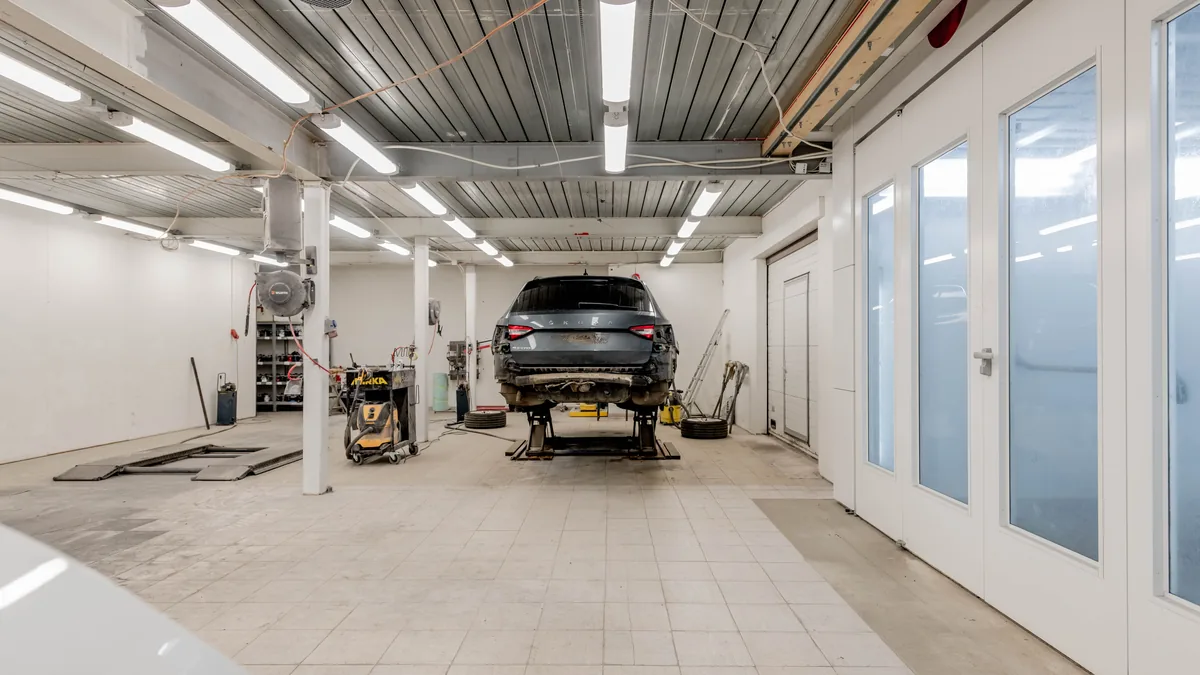
Service bays, tyre shops, body shops, detailing units and dealership showrooms all fall under this heading, and they have genuinely different requirements from one end of the building to the other.
Getting this right is mostly about zoning the specification rather than picking one product and rolling it everywhere.
What the bays have to survive
Chemical exposure. Brake fluid is the aggressive one, and it is unforgiving of an underspecified coating. Then engine oil, transmission fluid, coolant, battery acid, degreasers and solvents. Every one of these gets spilled eventually.
Hot tyres. Same physics as a residential garage, except vehicles come in hot all day. A rigid coating in a bay where cars are constantly being driven on and off will lift.
Point loads. Jack stands, transmission jacks, engine hoists and dropped tools. Concentrated load and impact, not distributed weight.
Lift installations. Two-post and four-post lifts anchor into the slab, and the coating has to terminate cleanly around the base plates. This is where poorly detailed jobs start peeling.
Constant traffic. Rolling toolboxes, creepers, floor jacks, and technicians on their feet all day.
What that means for specification
A high-build epoxy with a chemically resistant topcoat handles the chemistry well and builds thickness economically. Where hot tyre pickup is a concern, and in a busy service bay it always is, a polyurea base with a polyaspartic topcoat is the more reliable answer despite the higher cost.
Film thickness matters more here than in most environments. A thin decorative system in a service bay will not last, regardless of the chemistry.
Colour is a practical decision rather than a cosmetic one. Mid-tone greys hide tyre marks and oil drips far better than either light or very dark colours. A light floor in a service bay looks superb for approximately one week.
Lift points and anchor detailing
Worth its own section because it is the most common failure point we see in workshops.
Where a lift is anchored, the coating has to be terminated properly around the base plate rather than run underneath and cut. Anchors carry load and there is minor movement; a coating running under a plate gets crushed and works loose, and then moisture gets in around the anchor.
Where lifts are being installed after the floor, the anchor positions want to be known in advance so the terminations can be planned. Where they are already in, the coating gets cut in cleanly and sealed.
The same applies to bench legs, compressor bases and anything else bolted down.
Drains, wash bays and oil separators
Many Birmingham workshops have a wash bay or at least a drain in the floor. That area needs a system that tolerates standing water and cleaning chemicals, falls that actually take water to the drain, and a proper mechanical termination at the drain edge.
Where an oil separator is present, the floor around it takes concentrated hydrocarbon exposure and warrants a step up in specification.
The showroom and customer side
Completely different brief. Here the floor is part of how the business presents itself, and the exposure is foot traffic rather than brake fluid.
Polished concrete or a decorative flake or quartz system both work. Metallic systems create depth and reflectivity that suits a showroom floor and would be a waste in a bay. Light colours are fine because nothing is being spilled.
The detail that matters is the transition between zones. Where the showroom meets the workshop, there is usually a difference in system, colour and often thickness, and that line should be deliberate and clean rather than wherever the roller ran out.
Line marking
Bay boundaries, pedestrian routes, fire equipment zones and keep-clear areas around electrical panels. Applied into the coating system so it survives traffic, unlike tape, which does not.
Worth planning around how the shop actually works rather than how the layout drawing says it does.
Scheduling
Bay by bay is normal. A workshop that gives up one bay at a time keeps trading, and polyaspartic exists in this conversation because a bay can be back in service the next morning rather than the next week.
Lifts complicate this. A bay with a lift in it needs the lift lowered and clear, and any vehicle work planned around it.
Preparation is dusty. Containment between the bay being worked and the rest of the shop matters more in a body shop than anywhere, because grinding dust settling on wet paint is an expensive mistake.
What we need to quote
Bay count and total area, lift positions and types, where the drains are, what chemicals are actually used on site, whether there is a wash bay, whether a customer-facing area is included, and how many bays can be released at once.
We would rather walk the building. Workshop floors have more surprises in them than any other commercial floor: old coatings, oil that has soaked deep into the slab over decades, and slab damage under equipment nobody has moved in years.
For larger storage and parts areas, see warehouse floor coating. For the customer-facing side, retail and showroom flooring.
Common questions
Will brake fluid damage it?
Not a properly specified system. Brake fluid is the most aggressive thing on a workshop floor, and it is the reason the chemical resistance of the topcoat is the specification driver.
Can you coat around our lifts?
Yes, and how the coating terminates at the base plates is one of the details that decides whether the floor lasts. It gets cut in and sealed, not run underneath.
Our slab is soaked in oil after twenty years. Is it coatable?
Usually, after degreasing and grinding, though the worst areas sometimes need cutting out. Oil that has wicked deep can interfere with the bond, and that is worth finding out before quoting rather than during.
What colour hides tyre marks best?
Mid-tone greys, and flake blends more than solid colours. Light floors in a service bay look excellent for about a week.
How fast can a bay come back into service?
With polyaspartic, typically the next morning. With high-build epoxy, several days to full chemical cure.
We are a body shop. Is dust a problem?
Yes, and it is managed with containment and extraction. Grinding dust reaching a paint booth or a wet panel is the expensive version of this mistake.
Get a free quote
Tell us the space and roughly how big it is. We'll come measure it, and you get the scope and the price in writing.